
The idea behind CAMMP

CAMMP stands for Computational and Mathematical Modelling Program. It is an extracurricular programme offered by the Karlsruhe Institute of Technology (KIT) for school pupils of various ages. The aim of CAMMP is to highlight the social significance of mathematics and simulation sciences and to actively introduce young people to real-world problems.
At CAMMP, students take on the role of scientists and learn the basics of mathematical modelling using practical examples. In small teams, they work on challenging real-world problems from everyday life, industry and research, using mathematical methods and computer simulations. They are supported in this process by scientists.
The questions come from a variety of fields, such as the financial industry, aerospace engineering, video game design, medical imaging, climate research, renewable energies and current AI technologies. Mathematical tools such as modelling methods and numerical procedures are used to tackle these complex problems.
CAMMP is aimed in particular at students who are enthusiastic about mathematics, computer science and STEM subjects in general and who want to go beyond pure theory and engage in problem solving. Through longer and more intensive work on a specific question, they gain insights into the professional world of mathematicians, computer scientists and engineers.
The programme was originally developed at RWTH Aachen University in the CAMMP student laboratory and tested over several years. Since January 2018, CAMMP has also been implemented at KIT and is funded as part of the Simulated Worlds project.
CAMMP offers numerous activities for school pupils, teachers and students in the field of mathematical modelling, including, for example, CAMMP day (mathematical modelling day) and CAMMP week (modelling week). In addition, podcasts and short films provide further insights into the idea and work of CAMMP.
Project goals
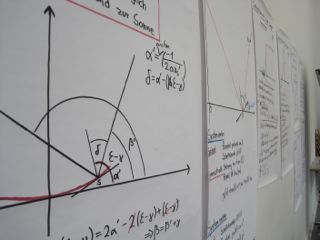
CAMMP aims to highlight the importance of mathematics and simulation sciences for our society. Through its programmes, CAMMP enables school pupils to actively engage with mathematical modelling in a playful way, thereby promoting both subject-specific and process-related skills. At the same time, CAMMP can contribute to career and study orientation.
Mathematical modelling comprises several steps, based on school curricula. First, a real-life problem formulated in colloquial language is translated into a mathematical model. This model is then processed and solved using existing mathematical knowledge. Finally, the results are interpreted, checked and evaluated, and presented in a way that is understandable for the users or those posing the problem.
By working in small teams, students also develop important process-related skills, such as communication and teamwork skills, as well as the appropriate use of hardware and software tools for problem solving.
In addition, CAMMP specifically combines the subjects of mathematics, computer science and physics, making it an ideal link to the school subject IMP (computer science, mathematics, physics). While physics provides the underlying laws of nature, mathematics uses iterative methods, among other things, which are ultimately implemented in computer science in the form of computer simulations (cf. Renate Allgöwer, Stuttgarter Zeitung, 14 August 2018).
In addition to the pupils, mathematics teachers also benefit from an intensive examination of mathematical modelling. For many learners, it is particularly motivating to experience authentic mathematics based on real-life problems.
History
Since 1993, the KOMMS project in Kaiserslautern has been offering a week-long summer course on mathematical modelling in Rhineland-Palatinate. This project week was initiated by Prof. Dr. Helmut Neunzert, former director of the Fraunhofer Institute for Industrial Mathematics (ITWM). Since then, events of this kind have been held regularly throughout Germany, Austria and Italy (South Tyrol).
In 2011, Prof. Dr. Ahmed Ismail¹, Dr. Nicole Faber² and Prof. Dr. Martin Frank³ founded the CAMMP project in Aachen. The first CAMMP week took place in May 2011 and has been held annually ever since. In 2012, another event format was introduced with CAMMP day. These are one-day modelling days where school classes or courses can learn about mathematical modelling at RWTH Aachen University. A year later, CAMMP was officially recognised as a student laboratory and has been part of RWTH Aachen University's EDULABS ever since.
In September 2015, co-founder Prof. Dr. Ahmed E. Ismail left the student laboratory to take up a position at the University of Virginia. In 2017, CAMMP expanded to a second location in Karlsruhe after co-founder Prof. Dr. Martin Frank moved to the Karlsruhe Institute of Technology (KIT) in September 2017 and set up the location there together with Maren Hattebuhr and Kirsten Wohak. Since 2019, additional events for students have been offered in Karlsruhe.
In the following years, the network was further expanded: since 2023, there has been another CAMMP location in Salzburg, and since 2025, there has also been a location in Stuttgart.
¹ Until August 2015: Chair of Molecular Simulation and Transformation, RWTH Aachen University; since September 2015: Molecular Simulation Research Group, West Virginia University.
² AICES Graduate School, RWTH Aachen University.
³ Until August 2017: MathCCES, RWTH Aachen University; since September 2017: SCC, KIT.